
Epic Transit Journey – The Columbia Basin to the Yakima Valley to the Kittitas Valley
Posted: November 29, 2011 Filed under: Epic Transit Journey, Fun, Transit | Tags: ben franklin transit, BFT, Community Connector, Ellensburg, People For People, Route 11, Yakima, Yakima Transit, Yakima-Ellensburg Commuter 6 Comments(If you’re new to the blog, I recommend reading my post on the last Epic Transit Journey I took.)
Earlier this week, I shared the news about a brand new bus route linking the cities of Yakima and Ellensburg (click the link to see the schedule and map at the end of the post). Since its way more fun to actually ride the bus and see it in person instead of just writing about it, I decided I would go ride it. But to make it more interesting, I decided that I would ride the bus to the bus. (Get it?) The following is a recap of everything that happened, along some photos I took along the way.
Regional Commuter Pass
Posted: November 27, 2011 Filed under: Transit Leave a commentIf you read my last post, you may recall me mentioning a monthly pass for the Yakima-Ellensburg Commuter. The pass itself costs $100 per month, and allows the holder unlimited rides on the Yakima-Ellensburg Commuter, as well as all other Yakima Transit routes and the Central Transit route in Ellensburg.
What’s interesting about the Yakima-Ellensburg Commuter pass it that it is the first multi-agency transit pass anywhere in Eastern Washington. And that got me thinking… Why aren’t there any others?
Route 11: Yakima-Ellensburg Commuter
Posted: November 26, 2011 Filed under: Transit | Tags: Ellensburg, HopeSource, Route 11, Yakima, Yakima Transit, Yakima-Ellensburg Commuter Leave a commentOn Monday, 11/28/11, a new bus route will start running. And this is a pretty big bus route. For the first time, the cities of Yakima and Ellensburg will be linked together by fixed-route transit service.
For several years (maybe even longer), there have been multiple proposals to link these two cities via transit. As it stands currently, the only non-car options are Greyhound (2 trips each way per day, costs $11-18 each way) and Bellair Charter’s “Airporter Shuttle” (5 trips each way per day, costs $10 each way). A non-profit organization based in Ellensburg, HopeSource, also has a demand-response/scheduled transit service that includes a trip to and from Yakima each Tuesday. If I recall correctly, fares weren’t collected on this service, though there was a “suggested donation.” However, for the most part, all these services are largely inconvenient for those needing to travel between the two cities. Greyhound is especially inconvenient, as it stops at a truck stop on the edge of town.
Transit Smartcards (I Have To Pay $5?!)
Posted: November 16, 2011 Filed under: Transit 1 CommentAs many a “transit nerd” knows, more and more transit agencies are rolling out smartcards. Rather than using the older-style “flash passes,” these cards function much like a credit card, storing either an “e-purse” or a pass. These systems help cut down time wasted on cash fumbling and can help improve ridership.
In the Seattle metropolitan area, their smartcard is called the “ORCA card.” ORCA, which stands for “One Regional Card for All” is used by 8 different transit agencies/operators in the area. However, one of the most prevailing complaints I hear about the ORCA card is the upfront cost of $5. This money doesn’t go towards any sort of fare payment, but is simply a fee to give people the “privilege” of owning their very own ORCA card. Many have argued that this fee should be done away with. Personally, I see no problem with it and feel it’s a fair price, but if I were in different shoes, such as those of a homeless person, I might feel differently.
Out of curiosity, I started wondering about other agencies and their smart cards. Is the ORCA card the only smartcard that requires an upfront fee? Do others charge less for theirs, or even more? Using this list from Wikipedia, I’ve compiled my own list below of the cost (or absence of cost) for each smart card that is currently used by transit agencies in Canada and the US. (For smartcards used by multiple agencies in a region, only the primary agency will be listed.)
The Finished Product (A New Ben Franklin Transit)
Posted: November 8, 2011 Filed under: Fun, Transit Leave a commentIf you follow me on Twitter or read the posts here on the blog, you know how I’ve been spending a lot of time thinking away on what to do with BFT. More specifically, what to do to make BFT better.
Obviously, I’m not a “real” transit planner. However, anyone and everyone has ideas, and mine just happen to be about transit a lot of the time. As I talked about a few posts ago, rather than focusing on what I wish BFT could have, I’ve been focusing on what BFT can have within the limitations of the current financial resources. I’ve said many times that the Tri-Cities has been very lucky in avoiding the majority of the economic downturn, but its starting to look like that luck might be running out. It’s a wait-and-see game at this point, but if push comes to shove, things could get very ugly around here, and I’d hate to see what that could do to BFT.
A while back, I posted a finished version of the map for my then-proposal for BFT. Looking back on it, my freshman effort was not that great. If I had to critique myself, I would say that my two biggest flaws were the directional arrows on every route marker, and the “rainbow.” (I don’t think I have to explain what “rainbow” means.) There are some people who like the rainbow, but in my opinion, it can be a pain on the eyes. When you have multiple colors in such a close proximity to each other, they tend to “bleed” into each other and can be very hard to look at. Plus, when you have multiple colors in use, it can make for some pretty big space consumers. Example, an old copy of the Dayton Street Transfer Point inset. (Link is to view the document via the Wayback Machine.) Another thing that must get serious consideration is accommodating people who are color blind. CHK America did a great job in addressing this issue when they did a recent revamp of the Spokane Transit system map.
Slowly but surely, I dumped just about everything from my first map and drew a new map. Take a peek below. (Click here or on the picture to view larger copy)
More Service For No Cost*
Posted: November 5, 2011 Filed under: Transit Leave a commentIt’s a simple idea. In order to bring better, or rather, “more” service, a sacrifice has to be made.
I’m looking at you mid-day…
The issue is that demand for bus service at mid-day is not as high as it is during the peak hours. If you look at the 22 bus routes that currently exist in the Ben Franklin Transit system, only 5 reduce service levels during mid-day: 41, 47, 48, 66, and 67. (Route 110 also technically falls into this list as well, since it runs at a 60-minute headway all day.) One of the most common complaints I’ve always heard about BFT is that their buses don’t run late enough. (There’s a reason why the Trans+Plus Night Service program was created.) So, why don’t we make them run later?
Route 120 – Delete It or Keep It?
Posted: October 28, 2011 Filed under: Transit Leave a commentRoute 120.
It’s been around since Ben Franklin Transit began, and has seen many, many changes. However, I think it may be time to say goodbye to the 120.
Below is a map of the route in it’s entirety. Can you see the problem?
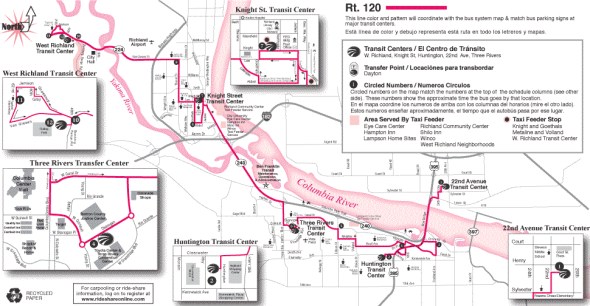
Route 120 Map
Photo Credit: Ben Franklin Transit
*This is not actually the most current version of the map, but it is the only copy on BFT’s website. The West Richland routing has changed.
End to end, Route 120 is 24.4 miles long in the eastbound direction (westbound is 24.2 miles). Except for the 170, this is BFT’s longest route. Schedule wise, the route has a run-time allocation of 1 hour and 30 minutes to get from end to end. The route is (mostly) very reliable though. During the PM rush hour, OTP can be an issue on the 120EB between Knight Street TC and Three Rivers TC, as well as both directions between Knight Street TC and West Richland TC.
Now, here’s my issue with the 120: It spends too much time running as a local route, not an intercity route.
How To Select A Seat On A Greyhound Bus (A Not-So-Very Scientific Study)
Posted: October 27, 2011 Filed under: Fun, Transit 1 Comment#transitmemory – How I Became a Transit Nerd
Posted: October 26, 2011 Filed under: Fun 1 CommentThis morning, @mamakoid posed this challenge to everyone on Twitter: “What is your first transit memory?”
Mine is pretty simple. Years ago when I was still a young’un and living in Whitehorse, my Mom, sister, and myself were getting ready to leave our house in Riverdale and head up to Takhini for our youth league softball games. I can’t remember if it was because we only had one vehicle at the time, or if we had one in the shop, but for whatever reason, we had to catch the bus since my Dad was going to need the truck to go to work. Though the bus stop was only 400 feet away from the front door, we ended up missing the bus by just mere seconds. We ended up having to take the truck, and somehow or another my Dad got to work. I blame my sister’s always prevalent ability to be slow at getting ready, though I think I might have had a bit of the blame on that day.
Since that story is kind of boring and short, I started thinking a little bit more about how I came to become “@ziggzagzac: Transit Nerd.” Curiously enough, I actually had part of this story already done and ready to go for my other blog, but since this is a transit-oriented blog, I decided to redo it a bit, and the following is what I ended up with:
Subtle Changes
Posted: October 24, 2011 Filed under: Transit Leave a commentAs I’ve mentioned several times here on the blog and on Twitter, I continue to work on what I feel is a solution to revamp the current service at Ben Franklin Transit for the better. However, in nearly every situation, as much as I try not to I find myself drifting away from what would be considered “realistic” and more towards “ideal.” However, for the time being, I want to tackle something a little bit simpler: Subtle Changes.
With the limited resources and funds available, it’s hard to extend the reach of our current transit service. With slight tweaks though, things can be improved. Below is a list of specific or general suggestions for ways that we can take the current Ben Franklin System and make it better without having to incur further costs.


 Transit 509