
Route 120 – Delete It or Keep It?
Posted: October 28, 2011 Filed under: Transit Leave a commentRoute 120.
It’s been around since Ben Franklin Transit began, and has seen many, many changes. However, I think it may be time to say goodbye to the 120.
Below is a map of the route in it’s entirety. Can you see the problem?
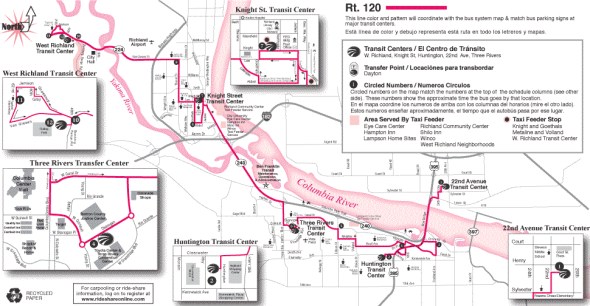
Route 120 Map
Photo Credit: Ben Franklin Transit
*This is not actually the most current version of the map, but it is the only copy on BFT’s website. The West Richland routing has changed.
End to end, Route 120 is 24.4 miles long in the eastbound direction (westbound is 24.2 miles). Except for the 170, this is BFT’s longest route. Schedule wise, the route has a run-time allocation of 1 hour and 30 minutes to get from end to end. The route is (mostly) very reliable though. During the PM rush hour, OTP can be an issue on the 120EB between Knight Street TC and Three Rivers TC, as well as both directions between Knight Street TC and West Richland TC.
Now, here’s my issue with the 120: It spends too much time running as a local route, not an intercity route.
How To Select A Seat On A Greyhound Bus (A Not-So-Very Scientific Study)
Posted: October 27, 2011 Filed under: Fun, Transit 1 CommentSubtle Changes
Posted: October 24, 2011 Filed under: Transit Leave a commentAs I’ve mentioned several times here on the blog and on Twitter, I continue to work on what I feel is a solution to revamp the current service at Ben Franklin Transit for the better. However, in nearly every situation, as much as I try not to I find myself drifting away from what would be considered “realistic” and more towards “ideal.” However, for the time being, I want to tackle something a little bit simpler: Subtle Changes.
With the limited resources and funds available, it’s hard to extend the reach of our current transit service. With slight tweaks though, things can be improved. Below is a list of specific or general suggestions for ways that we can take the current Ben Franklin System and make it better without having to incur further costs.
October 2011 Board Meeting
Posted: October 17, 2011 Filed under: Transit Leave a commentYou know the drill. Each month, the board convenes to go over the latest stuff, vote on any resolutions, and blah blah blah.
Several months ago, board member Richard Bloom, who is also a Hanford employee, brought up the idea of transit service to the Hanford area. Back in the day (1940’s to ~1995/1996), there was commuter bus service to the area, but that ended when the Department of Energy cut the money that helped subsidize the operation from their budget. One possible concept that has been floated around for this service is what’s referred to as a “Worker/Driver Bus.” It’s pretty much the same thing as a Vanpool, only on a much larger scale. Here in Washington State, only Kitsap Transit has an existing program like this. Though it is a good concept, a Worker/Driver program is unlikely to happen here in the Tri-Cities, as the bus operator’s union has made it very obvious that they’re against it. Tim Frederickson, the GM of BFT, told the union that this program would have no impact on existing service hours or the current workforce, but the union responded with the demands that service routes/specific work/destinations, as well as the type of vehicle, would have to be defined, and wage increases for everyone. There’s also consideration of expanding the MegaVan program (which right now consists of 1 25-passenger Vanpool), using 2 spare 30-foot buses, but it’s still being looked at for the time being.
Also covered were resolutions to extend current contracts.
Drop Off Only
Posted: October 8, 2011 Filed under: Transit Leave a commentEven as we see small incremental gains in the economy, things aren’t anywhere near back to “normal.” Because of this, transit agencies are still struggling financially and continuing to cut service, or even in a few cases, completely end service altogether. For Ben Franklin Transit, things aren’t horrible. The Tri-Cities has been mostly immune to the economic downturn over the last few years, but not 100%, hence why BFT now has reduced service hours, cut routes and trips, and instituted Saturday-only routes. However, there are still ways to help save money, without any serious repercussions to ridership.
When buses reach the end of the service day, ridership tends to be pretty low. (Whether that’s because people aren’t using it because there’s no service left once they disembark, or the demand just isn’t there is another story.) As such, when the bus reaches the very end of it’s route, 999 times out of 1000 it’ll be empty. Is there really a good reason to keep running the bus along the route when all the passengers have disembarked and nobody is waiting to board it? No. And that’s why I propose to institute a policy of “Drop Off Only.”
The Roundabout Bus
Posted: October 7, 2011 Filed under: Fun, Transit Leave a commentSeveral days ago, King County Metro launched their newest “BRT” (Bus Rapid Transit) line, RapidRide B, which runs between Bellevue and Redmond. (I use the term BRT cautiously, as there is a huge debate whether the RapidRide lines deserve to even be called that.) On my Twitter feed, I saw a post from @oranv about how the route travels through a roundabout, making it the only frequent-service route in King County to do so.
I found it a bit weird to see that this factoid would deserve such special recognition, mainly because roundabouts are so commonplace over here in my locale, Kennewick. As of now, the city of Kennewick has built 15 roundabouts throughout the city, and at least 6 intersections are slated to be rebuilt with a roundabout in the future. Though I’m about 99% sure the data is out of date, this info from WSDOT would imply that no other city in Washington State even comes close to this many roundabouts. The other cities of the Tri-Cities have also installed roundabouts. Pasco only has 1 on Road 44 (unless there’s others in the areas of Pasco I don’t frequent, though I doubt it), an area ripe with newer development, and doesn’t appear to have plans for more at this time. Richland has a couple, though I’m not sure sure of the exact number. They also have several traffic circles in the newer development in the south part of the city, though I think they’re better named “diet roundabouts.”
In Kennewick there’s a bus route, Route 47, that fully utilizes a good chunk of the city’s roundabouts. Along it’s route, it crosses through not one, not two, but five different roundabouts.
Sales Tax or Demand?
Posted: October 3, 2011 Filed under: Transit Leave a commentThe scenario: City A contributes the most tax revenue in a transit agency’s service area, but receives less service than City B, which contributes a smaller amount of tax revenue.
Is this fair?
Here in the Tri-Cities, which is served by Ben Franklin Transit, sales tax contributions are highly varied among the cities. For example, the amounts of sales tax collected by each city in July 2011:
- Kennewick (pop. 73,917) – $1,163,782
- Pasco (pop. 59,781) – $733,792
- Richland (pop. 48,058) – $814,435
- West Richland (pop. 11,811) – $ 58,102
- Benton City (pop. 3,038) – $26,476
- Prosser (pop. 5,714) – $95,654
- Kennewick – $15.75/520 hours
- Pasco – $12.27/392.5 hours
- Richland – $16.94/443.5 hours
Bus Schedules Are Racist
Posted: September 23, 2011 Filed under: Transit Leave a commentYes, you read that right. Bus schedules are “racist.”
Or we could just say that the creator of that claim isn’t all the way inside the bus, if you know what I mean.
The other day, I was riding Route 120EB between Huntington TC and 22nd Ave TC, with a 3/4 load. Before we’d left Huntington, there was a rider (a pretty regular rider at that) who was having a conversation with the bus operator about the recent changes to the schedules. In particular, the rider was telling the bus operator how the major changes to the schedules of the Pasco local routes was a sign of BFT’s racism against “colored” people. (This rider is Hispanic.) Apparently there were a few other people were listening to this conversation, as the bus became rather quiet at that point. The bus operator took that opportunity to escape back to his seat, where he didn’t have to keep chatting with the guy. In normal circumstances, I’ll usually interject myself in a discussion when it pertains to stuff about BFT, though there have been exceptions. This was one of them. I have talked to the guy once before, trying to help him find out about Taxi Feeder, and that got me nowhere.
September 2011 Board Meeting
Posted: September 9, 2011 Filed under: Transit Leave a commentAs I talked about in the intro of the post on last month’s board meeting, the board meeting is a chance to catch up on the latest info about BFT, and anything else interesting that might be going on. Last night, September 8th, was the latest edition of the board meeting, and it was definitely interesting.
After the convening and roll call of board members was taken care of, the next item in the agenda, like in every other board meeting, was the opportunity for citizen’s/visitors attending to address or mention anything that was not on the meeting’s agenda. And with that, I decided to raise my hand and address the board, which was the first time I’d ever done so. So you understand why, a back story might help explain this a bit better. On Sunday (during Labor Day weekend), I was continuing work on my little schedule and system map project for a BFT revamp that I’d mentioned here. In the midst of searching the website for a copy of the BFT logo without the “Transit” striking through it, I came across a part of the website that I’d never seen before. (For security reasons, that’s as in depth as I’m going to explain it.) With my very, very minimal knowledge of website design, I knew what I was looking at. And in this area of the website, I found something that I should not have been able to find: a list of all the Vanpool riders that had used BFT’s newly launched online payment system. Uh… not good. Now, the good thing was that they were not displaying the credit card numbers, but all the other personal info was still in plain sight. On Twitter, @TransitGuru helped me track down the logo I was looking for, but also said he was able to find the same thing I’d found, and it didn’t take him long either. Since it was Labor Day weekend, BFT was shut down on Monday, so I had to wait until Tuesday to talk to someone about it. Eventually, I got through to the right person, and though it was a bit of a shock, I could tell that they appreciated me bringing it to their attention. At the board meeting, I mainly just wanted to express that I was glad BFT officials handled the whole situation the way they did. The board even thanked me for my part in the whole situation, which was pretty cool.
With all that out of the way, why don’t I talk about the official business that went down…
Senior and Youth Fares
Posted: September 6, 2011 Filed under: Transit 2 CommentsBack on August 23rd, the Seattle Transit Blog had a post from guest writer Ann Dasch on the latest proposal for changes to the fare structure of Washington State Ferries. In the comments, there was a sub-thread discussion about the differences between youth and senior fares, where reader “Kpt” had this to say:
“This is perfectly easy to understand. Not sure what the confusion is about. Seniors vote. Kids don’t.”
Oh, how unfortunately true that is.
Exact figures lurk somewhere on the Internet, but the number of people 55 and over who vote tends to stay in the high 70’s, which is higher than any other age group. (18-24 from 2008 was only 58.5%.) Without delving into politics too much, it’s painfully obvious that a lot of the major decisions made in this country stem from the clout that senior citizens have. (Gun-control laws anyone?) When it comes to transportation agencies, you’ll rarely find an agency that would want to upset it’s more elder riders. For example, here in the Tri-Cities, riders 60+ years of age can ride fixed route services for free. In Seattle, persons 65+ who have obtained a Regional Reduced Fare Permit (which is also valid on 11 different agencies in the Puget Sound region) can ride for $0.75 at all times, peak or off-peak. In contrast, youth under 18 in the Tri-Cities must pay $0.80 for a fare. Seattle is a little more fair in this aspect, as youth only pay $0.75, just like seniors.
Just like what I did with the Day Pass post, I conducted a survey of all the agencies in Washington State to see what seniors and youth pay for a fare. The results speak for themselves.


 Transit 509