
Intercity Buses (and some stories)
Posted: August 22, 2011 Filed under: Fun, Transit Leave a commentPublic transit allows people to travel to destinations within a city or metropolitan area. But when someone wants to travel to another city outside of their area, what options are there?
You could drive. Sure. As long as you have a car, which means you’ll be paying for gas, insurance, registration fees, and unless your a driver that indiscriminately follows the speed limit, speeding tickets.
Maybe take a flight. …right. Airline travel is good when you need to get from Point A to Point B in a short amount of time, but it comes at a hefty price. Key word “hefty.” The average airline ticket price is hovering around $250 right now, and it still continues to rise. And that’s not even counting baggage fees, time spent getting to the airport, and all the time it takes to get through security just to get to your airplane in the first place.
Ride the train. Perhaps. If you live in the Northeast of the country, particularly the “megalopolis” of Boston-NYC-Philadelphia-DC, then Amtrak is a great option. But most people don’t live in the Northeast. Train service is sporadic at best in most of the county, especially west of the Mississippi River. Though things are improving in the Pacific Northwest and California, there’s still a long way to go.
That leaves only one option: the Intercity bus.
Day Pass
Posted: August 18, 2011 Filed under: Transit Leave a commentIn order to promote usage of transit by locals and tourists alike, many transit agencies will have a Day Pass, allowing unlimited usage of their services for that day. Instead of paying fare after fare every time you board a bus or train, you can just pay a flat fee for the Day Pass and not have to worry about anything. However, there are agencies that have not opted to put this sort of measure into use. Perhaps the greatest example of that here in the Pacific Northwest is the Puget Sound region (for this blog, defined as Snohomish County to Pierce County). Served by not one, not two, but five different transit agencies: Community Transit, Everett Transit, King County Metro, Pierce Transit, and Sound Transit. Of the five agencies, only Pierce Transit has a day pass. Even then, it doesn’t amount to much, as it’s only an available option on weekends and holidays with Saturday or Sunday service levels.
In the interest of being fair, I went through and did a survey of all the transit agencies in Washington State to see who has a Day Pass and who doesn’t. Some of the results were rather surprising, while others not so much.
1986 Guide to Summer Fun
Posted: August 16, 2011 Filed under: History, Transit Leave a commentWhile doing a search for an old map of Ben Franklin Transit Route 44 (a route that was discontinued a long time ago), I came across something interesting.
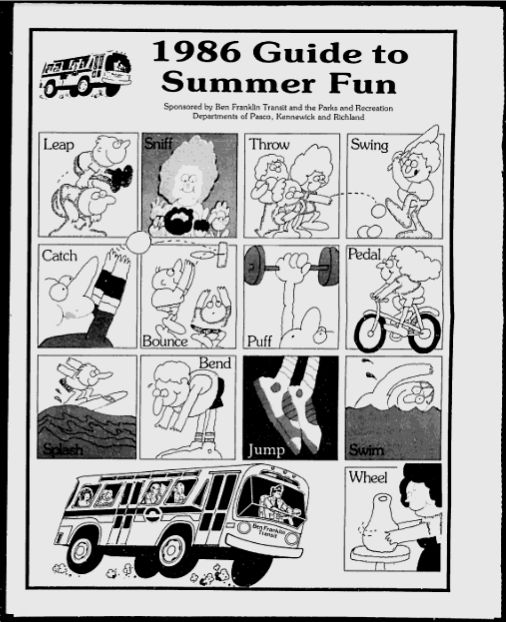 (If you’re interested in browsing through this guide, I’ve uploaded it to Flickr.)
Most of the guide is pretty generic summer stuff, but the biggest thing that caught my attention was that they included maps of the Ben Franklin Transit system from that time. Two major things to notice about this is that Interstate 182 hadn’t been opened yet (it would be opened later in the year) and the Blue Bridge was closed at this time for repairs. Below I’ll include clips of each’s cities routes.
August 2011 Board Meeting
Posted: August 12, 2011 Filed under: Transit Leave a commentLast night, August 11, BFT held their monthly meeting of the board. Though it is a rather simple affair, the board meeting brings to light a lot of information that normally isn’t circulated nor heavily advertised, but still is important none the less. The other benefit of going to the board meeting is that by doing so, I can get a copy of the board packet, a stack of documents and memos and whatnots that get passed out to each attending board member, as well as any member of the public attending who requests one (though I’ve never seen anyone else do it at the meetings that I’ve attended.)
With that in mind, I’ll go ahead and share a few things from last night’s meeting, as well as some new bits of information.
UPDATE: September 2011 Service Change
Posted: August 8, 2011 Filed under: Transit Leave a commentAs I mentioned before in this post, service changes to Ben Franklin Transit are scheduled to go in effect for next month.
Since the last post, a few updates have come up:
- Though they are referred to as the “September Service Changes,” the new schedules/routes will actually be going into effect on the last Monday of the month, August 29th. (September 1st is on the Thursday of that week.)
- In a notice posted at Three Rivers Transit Center, the notation for changes to Route 67 reads as follows: “In addition to regular routing Route 67 will run to CBC on school days and on weekdays becomes Route 66 at Road 100.” Columbia Basin College, or CBC, runs on a Monday-Thursday class schedule (with some exceptions), so I contacted BFT for clarification. They said that the extension to the CBC bus stop on Saraceno Way will be in effect for Route 67 (as well as Route 225) Monday through Friday, but only for Fall, Winter, and Spring quarters. As mentioned before, Saturday schedules/routes will still stay in their current form.
Also, though not necessarily new information (I merely forgot to mention it in the original post), the last change to schedules is that Saturday service levels will be instituted for the following holidays: Martin Luther King Jr. Day, President’s Day, Veteran’s Day, and New Year’s Eve. Christmas Eve will also see Saturday service levels, but the last departures will be at 1:00PM/1:15. As of now, there’s no word on how service for Route 170 to Benton City/Prosser will be affected by this. No changes will be made to holidays that already have no transit service.
Epic Transit Journey – The Walla Walla Loop
Posted: August 3, 2011 Filed under: Epic Transit Journey, Fun, Transit Leave a comment170 miles. 4 buses. $7.
Welcome to the highest levels of frugality.

Boarding the Tri-City Trolley at Huntington TC
Photo Credit: Zachary Ziegler
On August 2nd, myself and comrade @iAndrewPippin embarked on a trip that took us from the Tri-Cities to Walla Walla and back via Hermiston and Pendleton. Now, most normal people sleep during the hours of the night, particularly before any travel. But as for me, I stayed awake. All night. Watching Scrubs.
At about 4AM, I walked from my house towards Huntington Transit Center, meeting my buddie enroute and grabbing some snack food. After a healthy meal consisting of an apple juice and a Sourdough Jack with no tomato, we headed over to Huntington TC to wait for the Tri-City Trolley. The bus showed up close to on time at 5:39AM, and we boarded along with a gentleman who I’ve given the nickname of “Old Man Jenkins.” I’d say with about 99% certainty that there was alcohol running through his veins in the morning. Luckily, he slept nearly the entire ride. After boarding, we headed up to 27th Avenue Park and Ride, the last stop in the Tri-Cities, where another woman boarded, and after holding for about 5 minutes (to maintain the published schedule), we were on the highway.
“Transit cat grabs attention, mice”
Posted: August 1, 2011 Filed under: History, Transit Leave a comment (By Fay Tolley, originally published in the Tri-City Herald on July 9, 1989)
Ben’s a “fat cat,” she is.
And the crew at the Ben-Franklin Transit bus maintenance shop hopes she maintains her well-rounded figure.
The short-haired feline, dubbed Ben since she domesticated the workplace nearly three years ago, is a champion mouser and occasional snake snatcher, her custodians bragged Monday.
So the 22 maintenance workers who keep the system’s 53 buses in running order don’t have to worry about any unwanted varmints.
Don’t get the idea Ben’s day is all work, partsman Dick Cournyer said, stroking her mottled gray and orange hair.
Ben Franklin Transit on Google Maps
Posted: July 28, 2011 Filed under: Transit Leave a commentIt’s finally arrived!
Now anyone can use Google Maps to find the directions from any point in the Tri-Cities to any other point by using Ben Franklin Transit.
As far as I know, Ben Franklin Transit hired an outside firm to do this work for them, and so far through early testing, I’d say they did a pretty good job.
For a test, I decided to ask it to route me from the Wal-Mart in Richland to the Wal-Mart in Kennewick. On a Saturday.
“I Love This Bus”
Posted: July 27, 2011 Filed under: Fun, Transit Leave a commentIf you’re a county music fan, you’re probably familiar with Toby Keith. In 2003, he released a song called “I Love This Bar” which stayed in the number one spot on the Billboard Country Singles Chart for 5 weeks.
In 2010, a few of Ben Franklin Transit’s bus operators took Toby Keith’s song in a new direction. I present to you the music video for “I Love This Bus” by Ron France.
Efficiency
Posted: July 26, 2011 Filed under: Transit Leave a commentIt’s a tricky thing in transit planning.
Do you cater to the few who absolutely demand transit and provide them with excellent and accessible frequent transit, or do you try to cater to the masses, regardless of whether or not they’ve asked for transit service?
Case in point, the current debate in King County (WA). In short, King County Metro faces severe cuts to service unless a $20 Congestion Reduction Charge is approved by the county commissioners as a stop-gap measure until the state can approve a new or better source of funding. (Take a peek at SeattleTransitBlog.com for more in-depth coverage about this.) A problem that King County Metro has is the size of the area it serves. Except for the uninhabited areas in the east part of the county, Metro has routes serving the entire county. The pro to this is it opens the opportunities for people everywhere in King County to go where they need without relying a car. The con is that it costs money. A lot of it. One of the biggest examples of this is Route 209, which runs from North Bend to Issaquah. It is a very infrequent route (on average it runs once every 1.5 hours), and has a very low ridership. But, there are people using it. However, in an effort to conserve resources during these difficult financial times, many have proposed it would be better to cut this route and use the saved resources to serve people where there is much higher demand. And that is where the hard decisions begin. Do the low-ridership routes get cut in an effort to streamline the agency’s resources, or do all routes suffer the same cutbacks so that nobody will be completely cut off from their lives?


 Transit 509