
Tampa Bay Light Rail (Part 1)
Posted: December 31, 2012 Filed under: Transit 4 Comments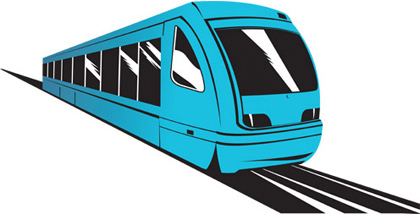 It’s been a hot button topic in Tampa Bay for many years: Light Rail – to build or not to build?
As early as the 1970’s, it’s been talked about over and over in the area. Advocates say that it’s years overdue, will better the economy of the area, and is a much more practical solution than continually building and expanding roads. Opponents say that the small number of transit passengers in the area doesn’t warrant the costly expenditures and maintenance and are vehemently opposed to any increase in taxes to pay for the system.
This is a pro-transit blog, and as such, I am on the side of the advocates. Having spent several months living in Tampa earlier this year, I got a first-hand look at just how badly the Tampa Bay area needs light rail. Transit ridership has been continually growing month after month (so many months in a row that I’ve lost track) on HART, and PSTA has been setting their own record ridership numbers. Keeping in mind that these ridership increases have happened in the midst of service cuts, fare hikes, and the recession, it’s fairly obvious that transit is proving itself.
Snow Detour
Posted: November 13, 2012 Filed under: Transit Leave a comment Over the course of the last few days, the Spokane area saw the first real snowfall of the season. So I figured now would be a good time to talk about an important snow-related topic: The Snow Detour. The fact of the matter is that the Spokane area gets snow. There’s no avoiding that. Sometimes, that snow accumulates enough to start making roads impassable. For people that ride transit, particularly those who are absolutely dependant on it, this can have serious implications.
The good news is that Spokane Transit has designated snow detours for 17 routes (more than half the routes in the system). On each route with a snow detour, the route map has the following info:
Pre-planned Snow Detours: Many bus route have sements that become blocked during snow-ice storms. Hills and narrow streets are the most common problem areas. Pre-planned detours (such as the one shown on this map) have been created so customers can plan accordingly. Detours will only be in effect as needed and for the minimum time possible. The STA wesbsite will always have the most up-to-date information on snow detours. You can also sign up for detour notices via Facebook, Twitter, RSS feeds, or SMS text messaging at www.spokanetransit.com.
 On that same route map/schedule, the specific snow detour(s) for each route are shown, with a short explanation of what street(s) the bus will drive on during the snow detour, and in select cases a more detailed explanation of what street(s) will not be served during the detour. A special notation is also seen on the maps for Routes 60 and 61, which bypass the Browne’s Addition neighborhood during snow detours, but retain service through a snow shuttle.
As noted earlier, snow detours only stay in effect for as long as needed. STA and the City of Spokane have worked together to make sure that the roads travelled by STA buses are on the priority list of roads that need clearing. From what I’ve been told by operators and riders, this plan usually works out okay, but it’s not always guaranteed. During a record-setting 17 inches of snow in 24hrs back in 2008, nearly all bus service was brought to a halt, but so was the rest of the region.
A 1% Tax Equals How Much Transit?
Posted: October 26, 2012 Filed under: Transit 3 CommentsBack in February, I wrote a post called “What Might Have Been.” In it, I talked about the aftermath of the repeal of the MVET (motor vehicle excise tax) in Washington State, and how it affected nearly every agency in the state. I was still living in the Tri-Cities at the time, so I focused especially on the effect it had on Ben Franklin Transit, and the amount of service that would’ve been lost had voters not approved an increase of the sales tax rate in 2002. After I wrote that, I ended up moving to Tampa for several months. While I was living there, I spent a lot of time riding the bus with Jason Eames (author of “Yo Bus Driver!”). Many times the subject of the abysmally low service frequency and hours of the local transit agency, Hillsborough Area Regional Transit, was discussed, and we both agreed that HART’s service was “small city transit in a big city.” As it turns out though, things might not have turned out this way had voters in Hillsborough County approved a 1% sales tax measure that was placed on the ballot in November 2010.
If the 1% sales tax measure was passed, 75% of the funds would have gone towards transit while the other 25% would have gone to road projects. This also included matching state grants and FTA funds for transit. According to the Hillsborough MPO, the old (and still current) property tax costs the average homeowner $45 per year to support transit service (in comparison with the average $720 in fares that each HART rider pays each year). The 1% would have cost the average household just $12 per month. Obviously, as an author of a blog with the word “Transit” in it, I’m very pro-transit and would have easily supported this measure. I’m fairly certain that the majority of my readers, especially my Tampa Bay area readers, would have as well. As part of the process to make the case for this new tax, officials at HART made a plan for the public to show how a 1% tax would benefit the community. The list is quite long, but yet impressive for a major metro that is behind the times on public transportation but doesn’t want to be.
Was “The Plaza” The Right Name?
Posted: October 24, 2012 Filed under: Fun, History, Transit Leave a commentIn 1995, Spokane Transit opened up their downtown transit hub. Called “The Plaza,” it’s arguably the crown jewel of transit in the Spokane area, and easily a contender for the best transit facility in the Pacific Northwest. Before the facility was opened, there was a long discussion between STA officials, city councillors, and the general public about what the name should be. Many names were proposed, but “The Plaza” ended up winning. In a slightly serious but mostly satirical piece, the Spokesman-Review made an argument for why “The Plaza” was the wrong choice.
Once again, the city of Spokane puts Plaza in a hole
(March 8, 1993)
Hasn’t Plaza suffered enough?
For more than a century, the little town 20 miles south of Spokane has been overshadowed by its bigger neighbor.
All that’s left in Plaza is a Grange hall, a grain elevator, and maybe a dozen house.
Now, the Spokane Transit Authority has decided to heap on more indignities by calling its downtown transit hole, er, center, The Plaza.
“Yeah, they’re stealing our name, aren’t they?” said Arlin Paulson at the Plaza Grange. “That just figures.”
The unincorporated town was settled in 1872, a year before Spokane Falls was officially recognized, and named after Plaza, PA.
At the turn of the century, Plaza had two general stores, a confectionery, two hardware stores, a blacksmith forge, a bank, two churches, and a school.
But Spokane began drawing Plaza’s commerce away and State Highway 195 was diverted so that it stopped going through town. Now the STA is stealing the town’s name. It’s a pattern of criminal neglect.
As unofficial (not to mention uninvited) legal counsel for the people of Plaza, we’d just like STA to note that we could be talking class action lawsuit. And that it’s not too late to change the name of that money pit.
How about The Rosalia?
Obviously, STA declined to act on the advice of the Spokesman-Review, and “The Plaza” stuck. Personally, I think it was the right choice. Though it’s primary function is a transit hub, it is also a center of commerce smack dab in the middle of downtown with multiple retail tenants, including a Subway that will be opening in the coming weeks. It’s also linked to other parts of downtown via the SkyWalk system. Changes will be seen in the coming months. The process has already begun with a modification of the Wall Street bus zones and opening the street to two-way traffic. Over the next year, major modifications will be done to the interior of the building, and the Sprague Street zones will likely be rebuilt to widen the sidewalks and create more room for waiting passengers. As changes happen, I’ll keep you all updated on that.
BFT Electric Bus Demonstration
Posted: October 3, 2012 Filed under: Transit | Tags: ben franklin transit, Complete Coach Works, Electric Bus, ZEPS 1 Comment
Zero Emission Propulsion System (ZEPS) Bus
As part of an initiative to be an innovator in green technology, Ben Franklin Transit will be participating in a demonstration project of an all-electric bus this year. Teaming up with Complete Coach Works of Riverside CA, the project will be funded with a grant for $750,000 that CalSTART (Pasendena CA), received. (It’s unclear who the grant is from.)
The Zero Emission Propulsion System (ZEPS) Bus is perhaps one of the most promising electric-powered buses to be developed yet. Promising a MPGe of 16.04, the bus is powered with a 180kw electric motor rated at 241hp. For batteries, the ZEPS Bus uses Lithium-Iron Phosphate batteries, which have many benefits, including longer cycle life, slower rate of capacity loss, more chemically stable, and less susceptible to overheating/igniting. With a range of 120-150 miles, the ZEPS Bus comes closer to equally the range of similar diesel buses than any other electric bus built before. The bus is also capable of running at highway speeds and powering an A/C unit while in motion.
Unlike most electric buses, the ZEPS Bus is not built completely from scratch. Using pre-existing buses that have already been carrying passengers, CCW rebuilds the bus and replaces the diesel engine/transmission with the ZEPS Bus drivetrain system. For the BFT Zeps Bus, the unit being rebuilt is #248, a 2005 Gillig 40′ Low Floor. #248 had been recently damaged in an accident in Richland and was already undergoing restoration at a facility in Las Vegas, so the timing of the ZEPS Bus project works out quite well. The rebuild of #248 into a ZEPS Bus is extensive enough that it will be issued a new VIN number and title. In regards to facilities, no major modifications will be needed beyond a charging station to be installed at BFT’s base. CCW states that it takes 6 hours to fully recharge the ZEPS Bus batteries, so it will be able to charge overnight and remain in service for most if not all of the service day.
According to CCW’s calculations, a single ZEPS Bus can remove 204 short tons of greenhouse gases per year when coupled with 100% renewable energy generation, and can save an agency $330,000 over 7 years in fuel and maintenance costs. With the Tri-Cities having hydro, solar, wind, and nuclear energy sources all in the immediate vicinity of the metro, the ZEPS Bus will easily be a 100% green technology initiative. Previously, BFT has done a demonstration of biodiesel in their entire fleet, and have had their new administration building certified as LEED Gold.
BFT staff have stated that the ZEPS Bus is set to debut sometime towards late fall or the end of the year. CCW was able to build the prototype ZEPS Bus in just 10 days, so there doesn’t seem to be too much of a risk of delays. Once the ZEPS Bus goes officially into service, I plan to head down to the Tri-Cities and check it out, as well as get some photos.
I Moved Again… (Blog Update)
Posted: September 17, 2012 Filed under: Blog Update Leave a comment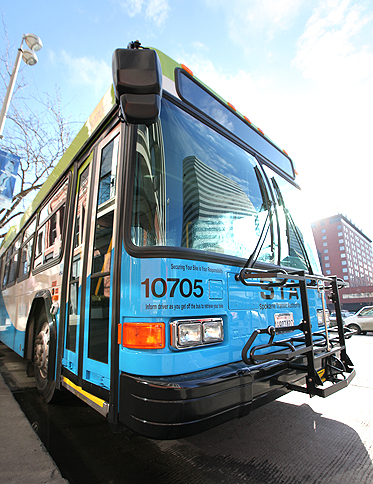 At the end of my last post, 85 Hours On The Bus (Part 2), I ended the story with my arrival in Spokane. What I didn’t mention then is that I’m actually living in Spokane now.
Some of you may recall how I moved to Tampa just several months ago. For the sake of keeping the story simple, let’s just say that I was ready for a change of scenery. (Someday, I’ll cover the story a little more in depth on my other blog.) Suffice to say, Tampa and Spokane are two very different cities, especially when it comes to the weather. Even though winter is fast approaching, I think it’s safe to say that I’m going to enjoy it in Spokane.
With a new city comes a new transit agency to talk about: Spokane Transit Authority. Perhaps best known for their astounding system map, I’ve been rather impressed by the agency so far. That’s not to say that they don’t have any shortcomings. Just like any other agency out there, they have weaknesses and flaws in the design of the system, which I will cover in future posts about STA.
Even though a lot of my posts will be covering STA now, I’ll still have posts from time to time on Ben Franklin Transit (Tri-Cities WA) and Hillsborough Area Regional Transit Authority (Tampa FL). In the case of the latter, I know there’ll be plenty to talk about in the coming months. Sadly, I was the only one to ever blog about BFT, which is why I want to make sure I still write about them, but updates on HART can still be found on fellow blogs “Yo Bus Driver!” and Tampa Bay Transit. In the near future, I hope to also have some more posts covering the operations/infrastructure aspects of transit.
Once again, I want to thank all my readers. I know the blog has done way too much shuffling around this year, so I appreciate everyone who has continued to follow along. Cheers!
85 Hours On The Bus (Part 2)
Posted: September 13, 2012 Filed under: Epic Transit Journey, Fun, Transit 1 Comment (If you haven’t done so already, read Part 1 of “85 Hours On The Bus”)At the end of Part 1, I had just arrived in Chicago for a 6-hour layover in the midst of my coast-to-coast bus ride. This is the conclusion of the story.
Layover in Chicago

Chicago Greyhound Station
With 6 hours to kill in the Windy City, I had to decide if I wanted to go play tourist for a short while or just take it easy. I went with the latter. Outside at the front of the station, I found a place to sit and eat a small lunch consisting of Triscuits, granola bars, and an Arizona Mucho Mango while watching people walk by. The thing that struck me as most interesting was that there was actually “life” on the street. People were walking by with their dogs, or riding their bikes, or heading home from the office. All too often, it seems that Greyhound locates their stations in run-down, dead areas of cities that nobody wants to go to. In modern times, that seems to be changing, and in the case of Chicago, it’s worked out quite well.
Since it had been almost two days since I was last able to get in contact with anyone, I decided to go wander over to the library. Luckily for me, it was rather close by. Per the directions from Google Maps, it’s a 0.9 mile walk that takes 19 minutes. In all honesty, it felt a lot shorter than that, even though I was hauling along a 30lb backpack. To be fair, it’s probably because I like Chicago. As I walked along I couldn’t help but marvel at all the different buildings and architectural styles, while at the same time reminiscing about things I remembered from the last time I’d been to Chicago.
Route 225
Posted: September 10, 2012 Filed under: Transit 1 Comment
BFT’s original logo
The odd child of Ben Franklin Transit.
To explain its origins, we have to go way back to the 1980’s. (Ok, so it’s not that far back…)
At this time, the Interstate Highway System hadn’t quite made its way to the Tri-Cities (as I-82 had completely bypassed the area by looping around and continuing south). In order to travel between Pasco and Richland, one would have to take Highway 14 across the Blue Bridge into Kennewick and then from there drive west towards Richland. However, once I-182 was opened, it presented a brand new option for residents of the region to drastically reduce their driving time, particularly Hanford workers.
When Ben Franklin Transit was first established, it utilized a rather simple numbering system. Numbers between 20 and 29 were reserved for routes serving Richland, 40-49 were for Kennewick, 60-69 were for Pasco, and 100-199 was for Intercity service. (There was also Route 10 which ran in West Richland, and Route 39 running as local service in an area split between Kennewick and Richland.) So, when BFT started running express buses to major employment destinations in the area, it was decided to reserve 200-299 to identify those routes. Examples include Routes 240 and 246 running to the Hanford Site. There were also buses to the Boise wood mill in Wallula (though short-lived) and other areas.
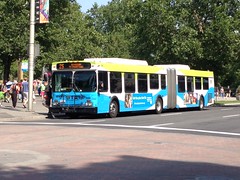
Is The Bus Too Big?
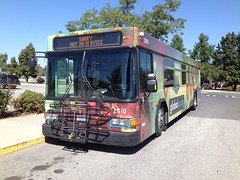
Posted: September 7, 2012 Filed under: Transit Leave a commentEvery now and then, I like to go on Ebay.com and take a look at the different buses being auctioned. Sometimes I might find a subtle difference on one bus compared to another, sometimes I find some pretty old buses, and sometimes I find buses that are just plain weird. Weird is probably the best word to describe one of the buses I found for sale: An Orion II.
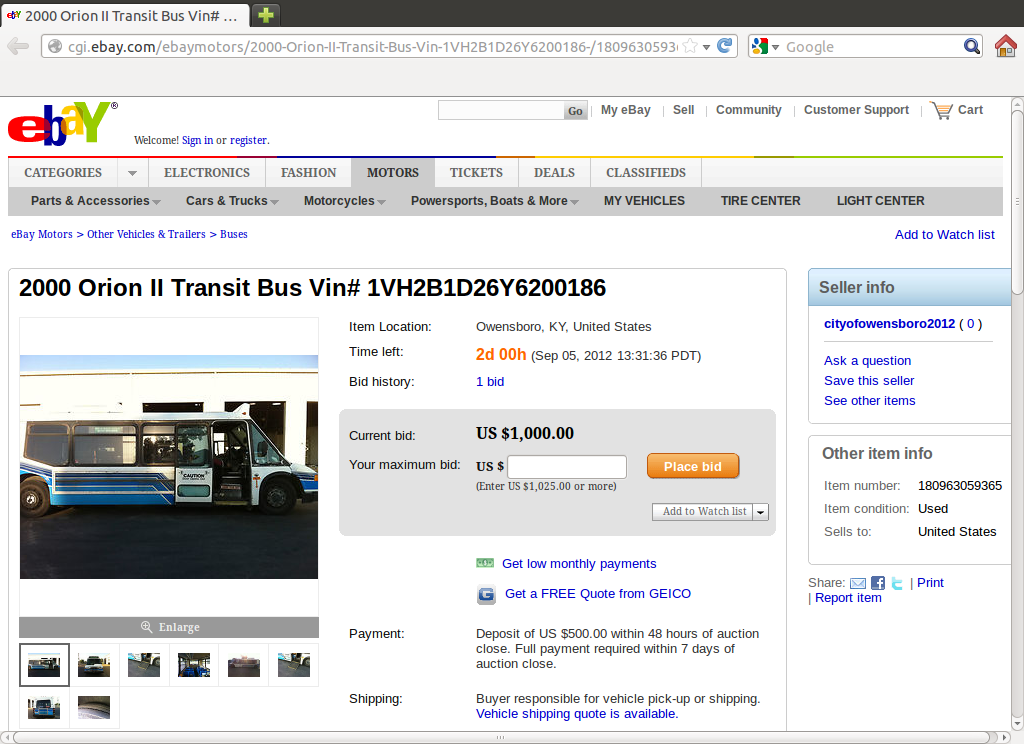
Auctioned by the City of Owensboro Kentucky


 Transit 509